

Captioned Speech and Audio
Captions provide a text display of spoken words and sounds for all types of media and communications. They can help people with hearing difficulties to better understand what is being said in conversation, entertainment or meetings.
Captioning can either be generated using automatic speech recognition (ASR) software—often incorporating artificial intelligence (AI)—or typed by a specially trained stenographer. It may be available for television shows, live or recorded video programming, performances, during videoconferences, phone calls, telehealth appointments and other events.
Closed captioning
Closed captioning (CC) provides the option to display subtitles for television, theater films or DVDs and on the internet.
- Captions can be accessed on TVs equipped with a decoder chip. Since July 1993, all television sets with screens 13 inches or larger for sale in the United States must have a built-in decoder chip.
- Check the product manual for instructions to turn on captions. Many remote controls now include a “CC” button to activate captions on televisions. Soon, closed captions will be easier to find and adjust thanks to a recent Federal Communications Commission (FCC) rule.
- To access closed captioning of online content like YouTube videos, look for the “CC” icon.
- At movie theaters, visit the Customer Service counter to request a decoder device from staff to access closed captions. You may receive either a cupholder caption device or wearable glasses that project captions onto the lens.
- Mobile apps are also available that provide prerecorded captions for popular films directly on your smartphone or tablet. Search your devices app store for options.
Although closed captioning primarily benefits people with hearing loss, recent studies show that many people without hearing loss, including younger viewers, activate captions while viewing entertainment to clarify on-screen dialog and digital content.
Open captioning
Open captions are integrated into the content itself and are visible for everyone to see, providing inclusive, universal access for viewers of all abilities.
- Open captions eliminate the need for additional equipment or decoder devices.
- Open captions are a permanent part of the film or video and are always viewable.
- A growing number of movie theaters designate select showtimes to screen open-captioned films, noted in the schedule with the “OC” abbreviation.
Communication Access Realtime Translation (CART)
Mostly used for live events, CART involves a stenographer, or steno typist, who translates speech in real-time to written words on a screen, either in person or remotely. This is similar to a court reporter that captures a manuscript of legal proceedings using a special keyboard and other equipment.
- CART is a form of captioning generated in real time by a live person.
- Human-transcribed captions tend to be more accurate and understandable than automatic.
- CART is most often used for live events like classes, presentations, conferences and theater performances.
- Captions may be projected onto a public screen or transmitted to individual mobile devices.
- Contact event organizers well in advance to submit your request for CART under the Americans with Disabilities Act (ADA).
Captioned telephones
Captioned telephones include a screen that displays a text version of what is said by the person you’re speaking to. In some states, these phones and other assistive technology are provided free of charge to individuals with hearing loss.
Mobile call captioning apps are available for iPhone and Android smartphones; some are certified by the Federal Communications Commission (FCC) and free to use by people with hearing loss.
Captioning apps and devices
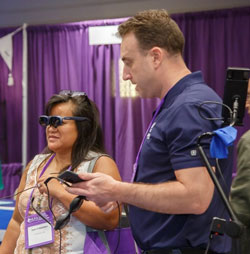 Captioning can be enabled on many videoconferencing apps like Microsoft Teams or Zoom, usually by turning them on in the settings. If captions are not provided as an option, contact the account administrator to activate them within their settings.
Transcription apps that provide real-time speech-to-text captioning are available for smartphones and mobile devices; some of these can be used in face-to-face situations, such as social gatherings or business meetings, while others are intended to caption phone calls for people with hearing loss.
The latest advances in this area include exciting technology such as captioning wearables, such as augmented reality (AR) glasses that automatically project captioned speech directly onto the lens, portable microphone kits that connect to an app and other innovations in development.
Where is captioning available?
The ADA requires that public places make reasonable accommodations for people with hearing loss. As technology continues to evolve, captioning is becoming more widely available, and even preferred by many without hearing loss who want to better understand speech and dialog.
Explore how specific platforms enable captions:
Improving access to mainstream communication platforms
The Communications Video and Technology Accessibility Act of 2023 (CVTA) will update captioning requirements for all media technologies and videoconferencing platforms. Learn more about ADA and CVTA.