

Listening in Public Venues
Hearing loops, installed in a wide range of public venues, provide ADA-compliant, accessible communications technology to people with hearing loss. These systems are designed to transmit sound from a microphone directly into listeners’ hearing aids or cochlear implants, or through a portable receiver, free from ambient or background noise, which greatly improves clarity and understanding.
What is a hearing loop?
A hearing loop is a form of hearing assistive technology (HAT) or assistive listening system (ALS). It allows you to receive sound directly into your hearing aids or cochlear implant processor equipped with a telecoil. A telecoil, or t-coil, is a small coil of wire inside a hearing aid that allows it to become a wireless receiver.
How does it work?
Hearing loops consist of a special amplifier and a hidden copper wire that transmits sound from a public address microphone via a magnetic field. The wire creates a “looped zone” in any size venue from a small ticketing booth to a large auditorium, sending the magnetic signal to any hearing device with a telecoil within the zone.

Benefits of hearing loops
Hearing loops can make speech and music in public places more understandable, allowing people with hearing loss to more fully participate at work, community activities and events.
Where are loops used?
You may find hearing loops installed in public venues like:
- Theaters, auditoriums and concert halls
- Airports, train stations and public transportation
- School classrooms or lecture halls
- Community centers
- Places of worship
- Banks
- Sports arenas
- Health care settings

Look for this symbol to identify places that are wired with a hearing loop system.
In spaces where hearing loops have been installed, you may have to ask staff to turn on the system. You may also need to activate the telecoil on your device to receive the signal. About 70% of hearing aids have a telecoil, and you should ask your audiologist about options for your particular hearing device.
Telecoils and portable receivers
Telecoils receive the magnetic sound signal inside looped venues and also enable listening via infrared and FM systems with the use of neck loops. Many hearing aid models come with t-coils or offer them as an option.
When buying a hearing aid, be sure to ask your audiologist or dispenser if a telecoil can be included and activated during the fitting.
If you don’t have a hearing device enabled with a t-coil, portable loop receivers with headphones or earbuds may be available to borrow from some venues. You can also use a streamer, personal amplifier or telecoil-equipped ear buds and a smartphone.
Know before you go
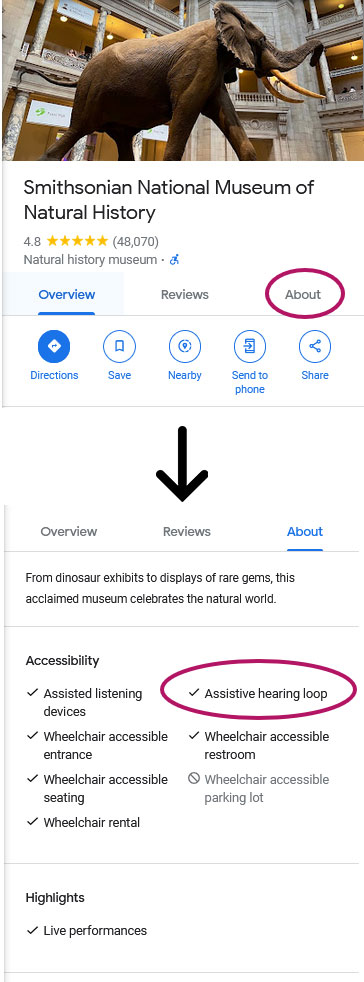
Google Maps may tell you if a venue is equipped with a hearing loop:
- On a smartphone, open a Google Maps listing. Under venue photos, look to the right to find the “About” tab and click on it. Scroll down to find the “Accessibility” section.
- On a computer, open a Google Maps listing and click on the right arrow next to the location description.
- For more details, read this blog article.
Click image to enlarge

Become a hearing loop advocate!
HLAA’s Get in the Hearing Loop (GITHL) community advocacy group works to raise awareness about hearing loops across the U.S. Learn how to be a loop advocate, and discover what you can do in your community.