Back Get Involved

WEBINAR—Breaking the Silence: Hearing Loss, Mental Health and Substance Use

A group of 6 people of diverse backgrounds providing support to each other.
14 May 2026 @ 2:00 pm ET - 3:00 pm ET WEBINAR—Breaking the Silence: Hearing Loss, Mental Health and Substance Use Webinars Read Post
Home » Media & Publications » Hear This! Blog

Hearing Aid Battery Packaging—What You Should Know

/
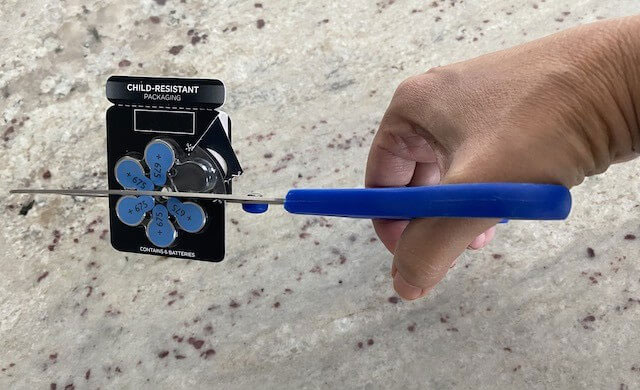
Scissors cutting into a hearing aid battery package.

Since 2024, hearing aid battery packages have become difficult for users to open, often requiring sharp scissors, strength and dexterity. Although frustrating, there are some valid reasons for the changes—mostly related to safety, longevity and regulatory concerns. It may help to understand what led to these protections.

Legislation Enacted to Protect Children

Enacted by Congress in 2022, Reese’s Law mandates safety standards for consumer products containing small round flat batteries—often called “button cell”  or “coin” batteries, used in various electronics such as remotes, toys and key fobs—to prevent accidental ingestion by children. It requires secure battery compartments, warning labels on both the product and packaging, and specific performance requirements to minimize the risk of children accessing or swallowing these batteries.

Display of cutting and opening a hearing aid battery package using scissors.

After the new law was passed, button battery manufacturers switched to child-resistant packaging standards to comply, including for non-toxic zinc-air batteries, such as those used in hearing aids.

Beyond child-resistance, there are other reasons for the intense packaging.

Battery Preservation

The packaging is often airtight or moisture-resistant to preserve the batteries’ shelf life. Zinc-air batteries, which are common in hearing aids, begin to lose power as soon as they’re exposed to air. So, the packaging must ensure they are sealed tightly until use.

Tamper Evidence

To ensure safety and integrity, many battery packs are designed to show if they’ve been opened or tampered with. This means using durable, sometimes difficult-to-tear materials.

Cost and Standardization

Manufacturers tend to use standardized packaging, even if the result is not the most user-friendly. The industry prioritizes safety and cost over ease of use in many cases.

What Can You Do?

Hearing Aid Battery Packaging Tips
  • Experts generally recommend scissors or heavy-duty shears to cut through the plastic on either side of the battery (“pie slice” cuts to center for easier access).
  • DO NOT collect unused batteries in a pouch or bag, as they will discharge upon contact with each other and exposure to air. Use older dispensers or purchase a battery caddy to keep them separate.
    A hearing aid battery case to store batteries.
  • Tools like magnetic battery pens can make removing and placing batteries easier, especially for people with arthritis or reduced hand strength.
    Magnetic pen pulling out a hearing aid battery from package.
  • Consider updating to rechargeable hearing aids when it’s time to replace your current devices.

Enjoyed this post? Never miss out on future posts by following us.


Get the latest news and updates from HLAA

Topics(Required)

HearingU Webinars

HLAA regularly hosts webinars on a variety of hearing wellness topics. View the upcoming schedule or watch a previous video.

Watch a Webinar


Follow HLAA on our social channels


If you or someone you know has a hearing loss, visit hearingloss.org for resources.

Find a local chapter or Walk4Hearing near you.

For questions, contact HLAA at inquiries@hearingloss.org.