I have hearing loss. This is the story of how I became a hearing advocate. My interest in the critical importance of effective communication in healthcare began in 2010, when I supported my hearing husband, John, through many arduous, painful months of cancer treatment. As John’s primary companion, I worked with him to understand his treatment options, progress and setbacks. We were a good team, as he often repeated what the doctors were saying, and filled in the things I didn’t hear.
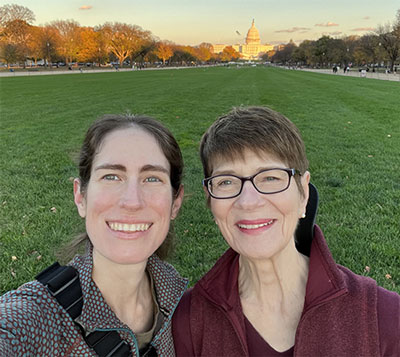
 When John was unable to speak and explain to me what the doctors were saying, I was unable to step in and be his voice. At these critical times our daughter, Claire, was with us as our hearing advocate translating what the doctors said, so I could stay involved with John’s care. Her help was imperative, and at the time, it seemed our only option.
Over the next few years, thanks to the Hearing Loss Association of America (HLAA), John and I both learned how to self-advocate using strategies and new technologies. Our communication teamwork was crucial as John developed hearing loss due to the chemo drugs and battled additional illnesses, including esophageal cancer that eventually took his life in January of 2022.
Knowing Your Rights
In 2010, I was not aware that the Americans with Disabilities Act (ADA) and the Affordable Care Act (ACA) mandate accommodations for effective communication for people with hearing loss, like me. That means that it’s up to the patient which reasonable accommodation works for them. For some, it’s an American Sign Language (ASL) interpreter, for others, it could be captions or a hearing loop assistive listening system that delivers audio directly into a hearing aid or cochlear implant (CI), like I have. For my husband and me, at the most critical time, our “accommodation” was our daughter. But I wondered what someone without access to this extra support would do.
Getting Involved, Learning to Advocate
In 2011, I started regularly attending the Hearing Loss Association of America (HLAA) Chicago North Shore Chapter meetings and a hearing support group. I learned from my new HLAA community the benefits of using hearing technologies and strategies, and the critical importance of advocating for my needs.
In 2014, I joined a group of HLAA Chapter members to listen to people who had distressing experiences in hospital settings. The next year, our chapter hosted a program with four Chicago-area hospital representatives who sat on a panel and told our audience what accommodations their hospital had for people with hearing loss. Turns out, they only had one—ASL interpreters. That works for only a small fraction of people with hearing loss that know ASL, and by law, the facilities should provide additional accessible communication options for patients who need them.
This HLAA event in October 2015 was the catalyst for an annual Hospital Safety Program that lasted for the next seven years, educating hospital staff about the needs of the hearing loss community. At these meetings, both John and I learned to become a hearing advocate for ourselves, and others too.
Plan Ahead for Hospital Stays
As a hearing advocate, I am acutely aware that the safety of people with hearing loss in hospitals and medical settings are at risk if they don’t advocate for themselves. Patients must tell the speaker they have hearing loss and quickly educate them about their communication needs. It means coming out of your comfort zone and speaking up about your needs—something many of us with hearing loss spend years avoiding. In a medical setting, you can’t avoid or bluff. Not hearing or understanding a diagnosis or medical instructions could be dangerous.
On May 1, 2024, I was scheduled for spinal surgery at a top hospital in Chicago. Because this hospital consistently sent a representative to the HLAA Hospital Safety Panel, I already knew of many of their available accommodations. I learned firsthand that as a patient with hearing loss, it’s critical to plan ahead.
I took several steps that made a difference:
- I called the hospital the week before my surgery and requested a live captioner—Communication Access Realtime Translation (CART)—during my stay.
- After registering on the hospital’s portal, I completed their questionnaire, which offered accommodations for patients with various disabilities. I checked the box that I read lips and wear both a cochlear implant (CI) and a hearing aid.
- I noted that my daughter Claire would once again be my advocate.
- I met with the neurosurgeon and explained that Claire needed to be with me as soon as possible after surgery.
When I got out of surgery, I was deaf and disoriented. As planned, the doctor summoned Claire, who stepped in and took charge. The nurse did not know how to attach the CI to my head or put in my hearing aid, so Claire was invaluable. I was flat on my back, making it impossible to see the captions from the CART provider.
Over the six nights I spent in the hospital, Claire was able to sleep in my room. She was on duty 24/7, helping me and looking out for my hearing needs. This was key to my successful care and recovery, along with our advanced planning and advocacy.
Here are some steps Claire recommends as a patient advocate:
- Learn to put the person’s hearing devices on ahead of time.
- Know how to recharge or replace their hearing device batteries.
- Discuss their communication needs, like facing them to speak, reducing background noise and the best way to get their attention.
- Does the patient hear better on one side?
- Bring paper and markers as a backup.
- Have a plan to keep track of the hearing devices in the hospital.
- Take extra batteries or chargers if possible.
- Be kind to the nurses and support staff…they will be patient advocates, too!


 When John was unable to speak and explain to me what the doctors were saying, I was unable to step in and be his voice. At these critical times our daughter, Claire, was with us as our hearing advocate translating what the doctors said, so I could stay involved with John’s care. Her help was imperative, and at the time, it seemed our only option.
 In 2014, I joined a group of HLAA Chapter members to listen to people who had distressing experiences in hospital settings. The next year, our chapter hosted a program with four Chicago-area hospital representatives who sat on a panel and told our audience what accommodations their hospital had for people with hearing loss. Turns out, they only had one—ASL interpreters. That works for only a small fraction of people with hearing loss that know ASL, and by law, the facilities should provide additional accessible communication options for patients who need them.
 When I got out of surgery, I was deaf and disoriented. As planned, the doctor summoned Claire, who stepped in and took charge. The nurse did not know how to attach the CI to my head or put in my hearing aid, so Claire was invaluable. I was flat on my back, making it impossible to see the captions from the CART provider.