At age 19, Melvin Allen volunteered for military service in his hometown of Chicago. After one year of training in communications and Morse code, he was sent to Vietnam as a Specialist E5 radio transmission operator with top secret clearance for the U. S. Army Security Agency.

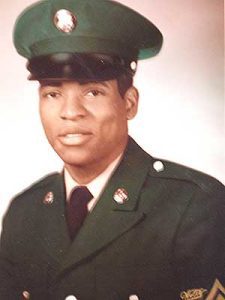
Melvin Allen’s 1966 U.S. Army photo
During his service there in 1967 and 1968, at the height of the war, he wore a headset 12 hours a day, six days a week to monitor enemy communications, while also being exposed to noise from heavy artillery fire. Following his tour of duty in Vietnam, Sergeant Allen served two more years in Germany, spending five long days each week inside a metal shipping container with loud sound reverberation and maximum headset volume.
Not surprisingly, upon retirement from the military, he was diagnosed with mild hearing loss—which went untreated until much later.
Turning Point to Treatment
Fast forward 38 years to 2008, when Melvin and his wife, Sherrie, enrolled in a psychology Ph.D. program together at Pacifica Graduate Institute in Carpinteria, CA. Partners in a successful Beverly Hills relationship and executive coaching practice, the couple had already earned master’s degrees and sought more extensive education to better support their clients.
“Up until that point, I had tried to compensate for my hearing loss for decades,” says Melvin, “but it just kept getting worse. In graduate school, I realized that I needed to finally do something about this, because I was missing so much in and out of the classroom.”
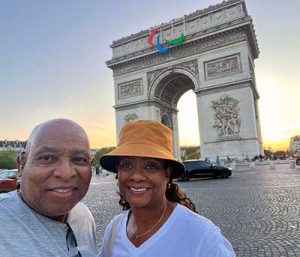
Melvin Allen with his wife Sherrie at the Arc de Triomphe in Paris, summer 2024
A visit to his local Veterans Affairs (VA) health care center confirmed that Melvin, then 61, had a service-connected hearing disability, and he was prescribed hearing aids.
Within 10 years, his hearing loss had progressed even further.
“By 2018, it had become difficult to understand my coaching clients, both in person and online during videoconference calls, even with my hearing aids—I found myself constantly asking them to repeat what they just said. I’ve always been extremely social and outgoing, but I began to isolate myself, because it was just too hard to hear and communicate.”
Finding the Missing Piece with HLAA
Melvin realized by then that he might need to consider the next step of getting a cochlear implant (CI). “But I spent two more years in denial of my condition before returning to the VA for help. I just wasn’t ready yet.”
Then he was invited to a meeting of the HLAA Los Angeles Chapter on January 25, 2020, by a friend from his master’s degree program who was a member. That day’s presenter was director of the University of Southern California (USC) Keck Medical Center’s cochlear implant program.
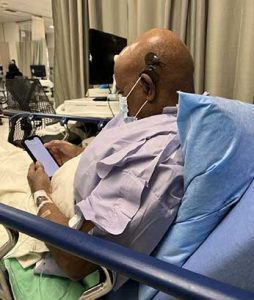
Melvin in the hospital before his second cochlear implant surgery in 2021
The information he heard provided the final piece that Melvin needed to move forward with his decision. Since the VA only had a single cochlear implant surgeon serving all of southern California at that time, they were referring patients to external providers such as Keck.
“I was implanted with my first CI through USC’s program during the Covid-19 pandemic in 2020,” says Melvin. “After going through the auditory rehabilitation process, my hearing improved so much that I went bilateral the next year, in 2021. They’ve made a huge difference in my work and my life.”
Advice to Fellow Veterans
Melvin encourages other veterans with hearing loss to seek treatment as soon as possible.
“Go get tested, find out how your hearing is, get hearing aids and do whatever is necessary. If your hearing aids don’t work, get cochlear implants if you qualify…forget the stigma, surgery fears, etc., and just do what you need to maintain your hearing and stay connected with the world.”
Melvin Allen and his son enjoy a Washington Commanders NFL game
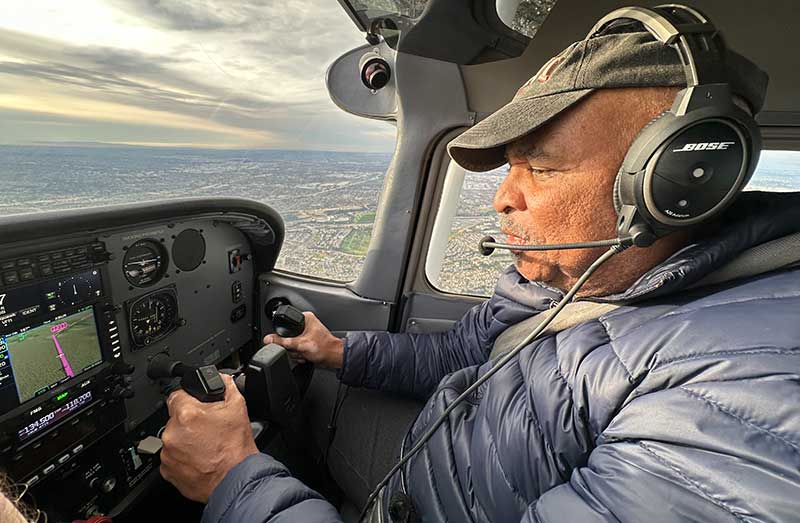
Today, Melvin and Sherrie continue their coaching and writing work remotely while traveling around the country and the world. A grandfather of two young women, Melvin describes flying out to attend a Washington Commanders football game recently with his son.
“I couldn’t believe that I was actually able to follow our conversation, even in the middle of a cheering crowd. My CIs have been life-changing and the difference in my hearing now is like night and day. If it wasn’t for them, I would just crawl into a hole and hide.”