A Chinese proverb says, “A journey of thousand miles starts with a single step.” On October 17, the Federal Communications Commission (FCC) took the final step of requiring all cellphones sold in the United States to be hearing aid compatible (HAC). This means that the phone has been tested and passed for both acoustic (bringing the phone to the ear) and telecoil (t-coil) coupling.
Read the FCC Press Release
View the October 17 FCC Meeting
This FCC order is the culmination of a journey that began half a century ago when David and Reba Saks, hearing aid users living near Baltimore, Maryland, discovered that certain public phones no longer worked with their t-coil-equipped hearing aids. The couple founded the Organization for the Use of the Telephone, Inc. (OUT) in 1973, creating an organized effort to get AT&T (which monopolized the industry at that time) to restore the magnetic emissions on its public payphones and to provide compatible handsets upon request.
As phones migrated from analog to digital to wireless, consumers with hearing loss were left with minimal or no access at first. The Hearing Loss Association of America (HLAA) has been there every step of the way over the past 45 years to improve phone accessibility and advocate for and help usher in this important regulatory milestone.
 What David and Reba would see today when they walk into their local mobile phone store is an array of smartphones with technologies that easily connect with hearing aids and cochlear implants (CIs), such as Bluetooth. However, under current FCC rules, only 85% of wireless phones in that store are required to be HAC, as phone manufacturers are permitted to include up to 15% of non-HAC handsets in their portfolios—although some manufacturers exceed that mix, with nearly 90% of HAC phones.
That puts the burden on consumers, who need to carefully review the websites of cellphone manufacturers and service providers to ensure that the phone is HAC before purchasing. Consumers must also insist that they can test their new phone (in store or at home) to determine that it works with their hearing aid or cochlear implant (CI).
Currently, there is no FCC requirement for Bluetooth coupling. Now, many phones can only connect directly to the hearing aid using proprietary Bluetooth technology such as Apple’s Made For iPhone (MFI), Android’s Audio Streaming for Hearing Aids (ASHA) or Cochlear’s Wireless Programming Pod (WPP).
After a transition period over the next two to three-and-a-half years, the FCC will require that all wireless handset manufacturers and service providers, both nationwide and regional, in the United States must offer products and services that allow for connectivity with prescription and over-the-counter (OTC) hearing aids and cochlear implant (CI) processors, as follows:
- 100% of their handsets can connect acoustically to hearing aids or CIs without interference
- 85% are able to connect to telecoils without interference
- 15% (after the transition) may have a non-proprietary Bluetooth connection to the hearing aid or CI
People who own older models of hearing aids without the technology to connect to their phones will need to upgrade. In addition, not all “handheld” phones have the capacity to connect to enabled hearing aids, such as many flip phones and other basic cellphones. The FCC order will change this dynamic, ultimately resulting in greater choices and options for consumers.
By the end of the transition period, equity and accessibility will be reached so that any buyer of a cellphone, hearing or with hearing loss, can choose from any manufacturer or model knowing that it will connect to hearing aids or CIs.

 What David and Reba would see today when they walk into their local mobile phone store is an array of smartphones with technologies that easily connect with hearing aids and cochlear implants (CIs), such as Bluetooth. However, under current FCC rules, only 85% of wireless phones in that store are required to be HAC, as phone manufacturers are permitted to include up to 15% of non-HAC handsets in their portfolios—although some manufacturers exceed that mix, with nearly 90% of HAC phones.
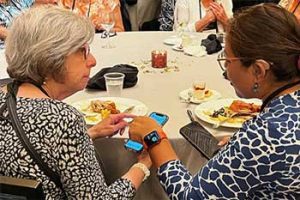 People who own older models of hearing aids without the technology to connect to their phones will need to upgrade. In addition, not all “handheld” phones have the capacity to connect to enabled hearing aids, such as many flip phones and other basic cellphones. The FCC order will change this dynamic, ultimately resulting in greater choices and options for consumers.