Teri’s Story
By Teri Breier
I received a cochlear implant (CI) in March 2025, four decades after getting my first pair of hearing aids. It took me eight years after qualifying medically for a CI to take that leap at 60. Now, after nearly a year of dramatically improved hearing, communication and human connection through this life-changing technology, I wonder: why didn’t I do this sooner?
The simple answer is, I just wasn’t ready…until I was. After a lifetime of using increasingly powerful hearing aids in response to the slow creep of progressive hearing loss, I expected there would always be a more advanced option to help.
Hearing Loss in School

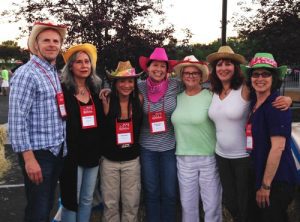
Teri (second from right) at her first HLAA Convention in 2017, enjoying Salt Lake City with a group of HLAA Los Angeles Chapter members, including several cochlear implant recipients.
I was diagnosed with mild sensorineural hearing loss at a school screening in first grade. It was 1971, before newborn hearing exams and the Education for All Handicapped Children Act (EHA) of 1975, which evolved into the Individuals with Disabilities Education Act (IDEA) in 1990. Aside from monitoring my condition, no intervention was prescribed by a doctor, and no one ever mentioned accommodations for students.
Throughout elementary, junior and high school, I instinctively sat near the front of the classroom so I wouldn’t miss anything. Although I did well academically, I increasingly struggled to understand my teachers and conversations with classmates. By age 16, my hearing loss had declined from mild to moderate—but at that age, I was not willing to be “the girl with the hearing aids.”
College and Career with Hearing Aids
As a freshman in college, despite the large lecture hall acoustics, I followed well enough to keep up my grades. But upon returning to Los Angeles that summer, my grandmother insisted that I finally get hearing aids. Thank goodness she did, because wearing them made a huge difference in my ability to learn, understand, communicate and connect with peers.
Teri with Toni Barrient, HLAA southern California Chapter coordinator and president, HLAA Orange County Chapter, at the 2017 Long Beach Walk4Hearing. Toni was another person who influenced Teri’s decision to get a CI.
Nevertheless, I continued to hide my invisible disability from others, because of perceived shame and social stigma. I spent the first 30 years of my journalism, advertising and marketing career trying to blend in. I eventually left the corporate world and went into business for myself as a freelance copywriting consultant.
As my hearing loss worsened over time, it became harder to bluff my way through work, life and, eventually, my beloved hobby as a choral singer. Often, I felt deeply embarrassed when I misunderstood someone or sang out of tune, so I found myself quitting choir, pulling back from social interactions and isolating more.
The Support and Influence of HLAA
By the time I discovered the Hearing Loss Association of America (HLAA) in 2015, I had done extensive inner healing work, gained confidence and was ready to “own” my hearing loss more openly. I soon became involved in leadership of two consecutive HLAA Chapters and made new friends with cochlear implants who encouraged me. Almost without exception, they said it was the best decision they had ever made.
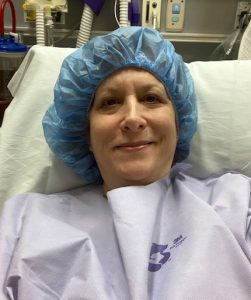
Teri prepped for her outpatient cochlear implant surgery.
I began the CI medical qualification process in 2017, but didn’t proceed at that time. I was still “getting by” and scared to lose my remaining residual hearing and enjoyment of music, among other fears. I didn’t know if I could maintain my business during the long downtime needed for recovery and aural rehabilitation. Meanwhile, I continued to be active in HLAA, attending some of the annual conventions and volunteering for the Long Beach Walk4Hearing.
In 2023, I joined the staff of HLAA, which has, gratefully, allowed me to make a meaningful difference for other people with hearing loss around the country. Collaborating on a daily basis with colleagues who wear CIs motivated me to take action and stop missing out on life.
My First Year with a Cochlear Implant
Luckily, I was able to understand speech from the first moment of my CI “Activation Day” in April 2025—even though every sound and syllable was overlaid by annoying robotic whistles and echoes, as my brain attempted to make sense of these new digital signals. With consistent aural rehabilitation practices, those noises disappeared after three months.
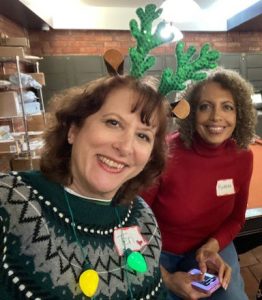
Teri with fellow HLAA Los Angeles Chapter member and recent CI recipient Ramona Lee at the 2025 holiday party.
Since then, I’ve picked up high frequencies that I haven’t had access to since my 20s. I’m enjoying (and sometimes getting annoyed by) the sound of birds again on a daily basis. I can now understand songs and commercials on the car radio and talk on the phone without captions. Just this week, I was elected to serve as president of the HLAA Los Angeles Chapter—the next step on my hearing health journey! It feels like a whole new world is open to me now. Best of all, I finally feel like my old self, actively participating in conversations, relationships and daily life.
For now, I remain bimodal (that is, I use a hearing aid in one ear and my CI in the other). But I am considering when to get a second CI. Every day, I am so grateful for my cochlear implant, and especially for my role models in HLAA who showed me what is possible.