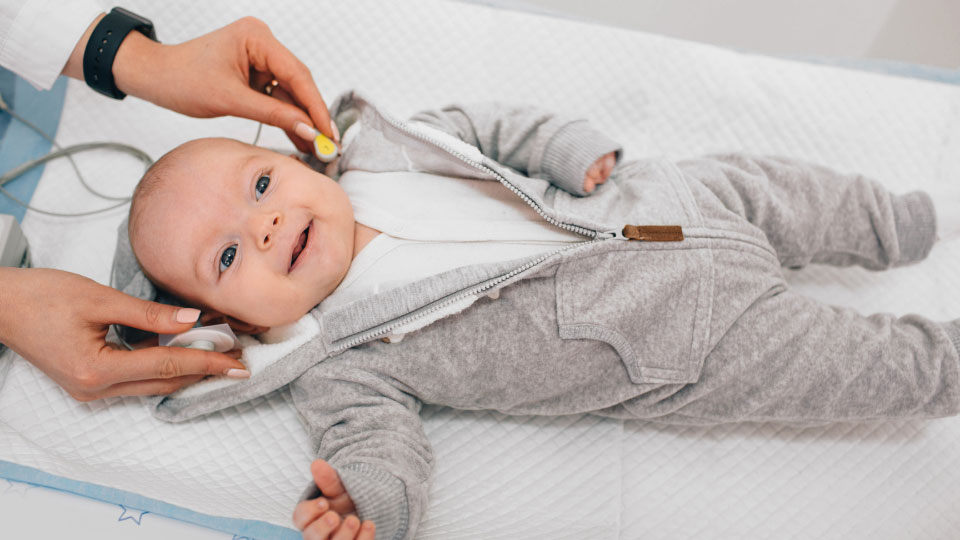
Before 1993, fewer than one in 10 newborns in the United States were screened for hearing loss. By 2025, thanks to decades of advocacy and public health efforts, an estimated 98% of all newborns receive this critical screening. Today, this hard-fought success is in jeopardy from proposed dramatic federal budget cuts, putting our nation’s infants again at risk.
Advocating for Newborn Screening
This public health success story began in the 1990s, when the Hearing Loss Association of America (HLAA) and other advocacy organizations championed the passage of the Early Hearing Detection and Intervention (EHDI) Act, which became law under the Children’s Health Act of 2000. Since then, the EHDI Act has been updated several times, most recently in 2022, when Congress reauthorized annual funding for both Centers for Disease Control (CDC – $10.7 million) and Health Resources and Services Administration (HRSA – $17.8 million) through 2027.
“Passing the EHDI law was a huge success for HLAA and its advocacy partners,” said Barbara Kelley, Executive Director of HLAA, the leading voice for the growing number of Americans with hearing loss. “It means that parents know before they leave the hospital whether their newborn’s hearing is functioning properly, and if not, take immediate action to provide early intervention for their child.”
Why This Matters
One in 500 babies are born with hearing loss or develop it in early childhood, which ranks among the most common congenital conditions. With hearing loss numbers rising, early detection and intervention is critical to ensuring that children meet speech, language, social and emotional development milestones.

98% of U.S. newborns get their hearing screened each year, thanks to the Early Hearing Detection and Intervention (EHDI) Act of 2000, for which HLAA advocated.
The EHDI story is held in high regard by many HLAA members from the organization’s nationwide network of support. Many are now in their 50s and 60s—born before that legislation passed—and did not get diagnosed with hearing loss until later in childhood or even as young adults. Pre-EHDI anecdotes abound about delayed intervention. Most say the lack of early diagnosis caused lifelong issues, including delayed speech, academic challenges and trouble making friends. Had their families been alerted earlier of their hearing loss, timely treatment and accessibility might have given them more confidence, equipment and support services, potentially changing their lives’ trajectories.
For instance, one person on our national staff was diagnosed with genetic bilateral hearing loss at age seven, yet didn’t receive hearing aids until her sophomore year of college, after struggling to hear in class and connect with peers all through her schooling. With the benefit of EHDI, her family likely would have learned about her hearing loss and treatment options much sooner.
Since its passage, EHDI has helped states dramatically improve newborn hearing screening rates—from just 46.5% of infants before the program to nearly 98% today. Between 2018 and 2022 alone, more than 320,000 children received diagnostic services after failing initial screenings, and more than 19,000 children were enrolled in early intervention.
EHDI Supports State Programs and Research
The EHDI program accomplishes three key objectives:
- Supports state data systems: Directs the CDC to fund and assist states in developing and maintaining data systems to evaluate progress, inform research and policy, and identify gaps in follow-up services.
- Provides state grants: Funds the HRSA to award grants that help states implement and improve EHDI services through technical assistance.
- Encourages research: Promotes hearing research at the National Institutes of Health (NIH) through projects supported by the National Institute on Deafness and Other Communication Disorders (NIDCD).
This progress—decades in the making—is now in jeopardy.
State Programs Will Suffer Without Funds
Recent federal budget proposals would eliminate all HRSA grant funding that supports newborn hearing screening programs. Without this funding, many states may be forced to scale back or discontinue their screening services entirely. Our country would be returning to a patchwork of protection for infant screenings, depending on where they are born and potentially burdening families with additional costs.
In addition, a recent reorganization within the Department of Health and Human Services (HHS) has eliminated CDC’s role in data collection and program assessment—functions that are essential to the success of early hearing detection and intervention efforts at the state level.