Planning ahead and knowing your rights can help
A recent news story about a senior woman’s air travel nightmare highlights problems many of us with hearing loss may experience when we fly. Often announcements and even safety information aren’t accessible. How can we stay safe, remain informed and minimize issues while traveling?
Airport nightmare in Austin
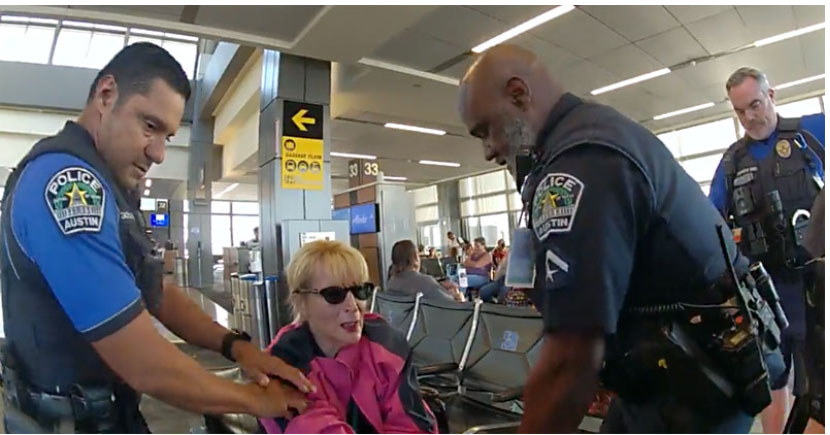
According to the Austin Chronicle, Karen McGee, a 71-year-old woman with hearing loss flying alone for the first time last September, missed her connecting flight during a layover at Austin–Bergstrom International Airport in Texas when she didn’t hear a gate change announcement. She reportedly became agitated when airline personnel couldn’t communicate with her.

Karen McGee and police at Austin airport (screenshot via Austin PD bodycam footage)
Austin news station KXAN reports that police were called but had trouble communicating with her. The details aren’t clear, but in the end, McGee was apparently arrested for trespassing, handcuffed, taken to the local jail, detained for two nights, and ended up with a broken wrist.
What happened in Austin—however elusive—brings up some of our worst fears as travelers with the invisible disability of hearing loss. Regardless of the details in this particular case, we can learn from it and make our own travels less distressing with a bit of preparation.
Discrimination against travelers with disabilities is illegal
The Air Carrier Access Act (ACAA) is a 1986 law—predating the Americans with Disabilities Act (ADA) by four years—that makes it illegal for airlines to discriminate against passengers because of their disability. The Department of Transportation is responsible for enforcing the ACAA, which applies to all flights to, from, or within the United States.
One of its provisions is that anyone self-identifying as a passenger with a disability, who needs additional time or assistance, must be allowed to board the airplane before other passengers. Hearing loss is considered a disability under the ACAA, just as it is for the ADA.
Lise Hamlin with her hearing dog, Shine, at an airport
Self-identifying can help
I once almost missed a flight because I did not hear the boarding announcement at a very busy area with multiple gates at Reagan National Airport. Another time, I missed an important safety announcement about the plane’s potential landing gear issue during a flight descent. Luckily, in both cases, I was able to avoid serious complications, but since then, I have self-identified at every point in the travel process: when purchasing my ticket, at the ticketing counter, at TSA security, at the airline gate, when boarding the plane, and if needed, at baggage claim.
By staying alert to my surroundings, I have never missed a flight. I also make sure the airline knows in advance I am flying with my hearing dog, Shine, and complete all the required service animal paperwork. Gate personnel often help me understand the preboarding announcements and ensure I get on with those in front of the line.
Airline agents responsible for providing accommodations
Had McGee been aware of the ACAA, she could have disclosed her disability and requested preboarding at her first gate. At that time, flight agents would have been required to ensure that she receives the same information as everyone else. She would have learned about the gate change, found the new gate, and been allowed to preboard successfully.
McGee may not have known her rights under the ACAA, which is not uncommon for the millions of us who now have hearing loss. Had she known and self-identified, what could the gate agents have offered as accommodation? One option might have been hearing loops, an assistive listening method provided by a growing number of public spaces including airports. Hearing loops can feed sound directly into a person’s hearing aid or cochlear implant when equipped with a telecoil.
According to the Accessibility page of its website, the Austin Airport has a loop installed between Gates 1 and 12. If her hearing aids had an activated telecoil, a mechanism to receive the input from a hearing loop, and if the agents knew how to use the hearing loop, it’s certainly possible that McGee could have communicated more effectively and made it to her connecting flight.
But an air carrier’s responsibility doesn’t end if one’s hearing device doesn’t work, or if the gate is not equipped with a hearing loop. There are far more options to provide access than even a few years ago. Speech to text apps on a cellphone or tablets provided at gates could be used. A pocket talker, or small sound amplifying device, might have been available. Even old-school pen and paper could be used in a pinch.
A call for more awareness, education and empathy
Beyond assistive technology, the most important accommodation is simple compassion and understanding for people traveling with disabilities. In this case, communication broke down and gate agents had the police take this 71-year-old woman with hearing loss to jail.
Lise and Shine at home
It’s important to note that airports are complex places and accessibility falls under multiple jurisdictions. For instance, in this case, the airport itself is under the jurisdiction of the city of Austin, which must follow ADA regulations as well as Federal Aviation Administration (FAA) rules. Departure gates, ticketing counters, airplanes and baggage fall under the ACAA for people with disabilities, so Austin has no control over what the air carriers provide.
The ACAA has been law for decades, but still very few people are aware of it. Had McGee or the flight agents been more knowledgeable about this law, her harrowing experience may have been avoided. The Hearing Loss Association of America (HLAA) continues to advocate for more comprehensive training about required accommodations under both the ACAA and ADA, for all airline and airport personnel, and enhanced assistive communications at every airport such as visual messaging, hearing loops and more. With our support, Congressional co-sponsors have proposed a new ACAA Amendment Act, requiring more text and accessible information. HLAA also wants passengers with hearing loss to be empowered with information before they travel.