How Veterans Are Conquering Hearing Loss
Military service often involves exposure to high-decibel sounds such as gunfire, explosions, heavy machinery and other activities that exceed safe listening levels. As a result, hearing loss, including tinnitus, affects 3.6 million military veterans, making it the most common service-connected disability, according to the U.S. Department of Veterans Affairs (VA).
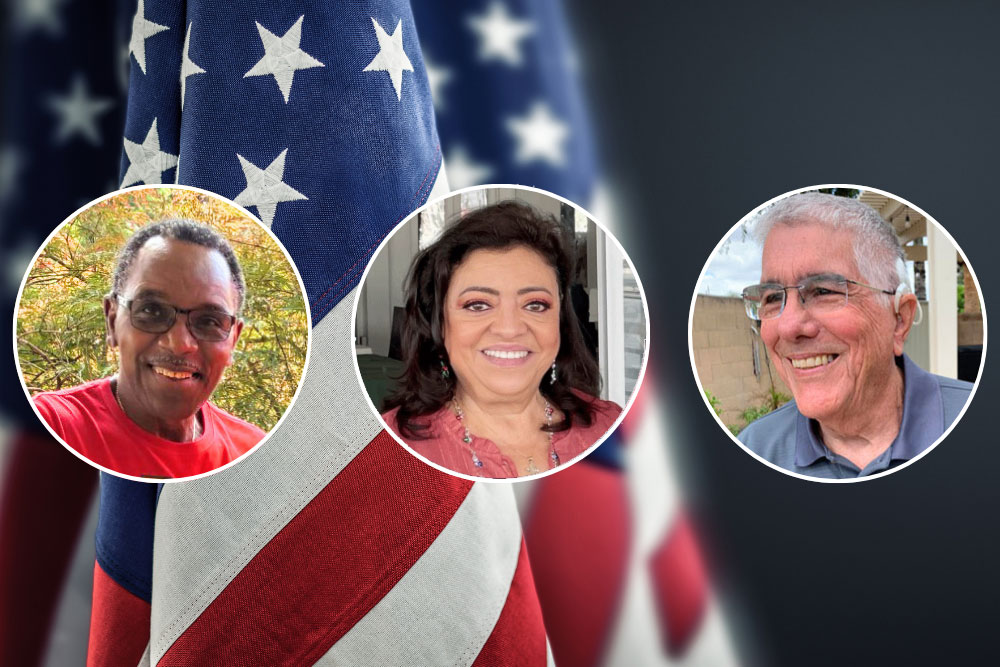
Veterans are an important and valued part of the nationwide Hearing Loss Association of America (HLAA) community. We provide veterans with educational resources and objective information about assistive technology, as well as peer support and shared experiences through our Veterans Across America Virtual Chapter (VAAVC). In honor of Veterans Day, we asked three HLAA Chapter members who are veterans to share their stories about the impact of hearing loss.
Miryam Fernandez: Breaking Barriers in the Military and Beyond

Hearing loss background: Miryam, 69, has noise-induced sensorineural damage from firing practice. She wears bilateral hearing aids and serves as the treasurer of HLAA Long Beach/Lakewood Chapter in southern California.
Military service: U.S. Air Force (1975-1979), rank A1C (Airman First Class), Air Force Academy Security Police Squadron
Miryam’s story:
“My family emigrated from Peru to Southern California in 1962, when I was five years old. My parents, younger sister and I are products of the “American Dream.” As a young Latina girl, I was fiercely independent in a strict and traditional Latino family. I decided to join the Air Force after a recruiter spoke at my high school. Although my job and training were in clerical work, once I was stationed at the Air Force Academy in Colorado Springs, my supervisor changed my assignment and I trained to become a security police officer.
“I served for four years, then finished college and became an elementary school teacher in Long Beach and Los Angeles. Several years following my discharge, I was diagnosed with severe sensorineural hearing loss. At the time, I was told that hearing aids weren’t an option for the 75% hearing loss in my left ear because nerves do not regenerate. Decades later, the U.S. Department of Veterans Affairs (VA) determined that my noise-induced hearing loss was caused by firing practice.
“The only treatment provided by the VA was hearing aids. However, none of the products I tried addressed my biggest problem, which was hearing clearly in background noise. As a result, I didn’t wear my hearing aids much. But as my hearing is slowly getting worse as I age, I find that they do help somewhat, so I’ve learned to use them more often, especially when I’m going somewhere where there is going to be a lot of background noise. I hope that during my lifetime, technology will advance to provide hearing aids that allow users to understand speech with more clarity.
“Before retiring, I started researching hearing loss groups. When a new principal at my school learned that I had hearing loss, he asked if I was ever provided with accommodations. I replied, “For what?” He explained the American Disabilities Act (ADA) to me and gave me some materials and supplies. That research led me to the HLAA Long Beach/Lakewood Chapter where I served as secretary for four years and am now the treasurer. Discovering and joining HLAA has opened up a world of resources and information for me. I am a lifelong learner and enjoy technology so I’m interested in how it can assist those of us with hearing loss. I’m grateful to be part of a supportive community that can relate to the difficulties I face daily because of my hearing loss.”

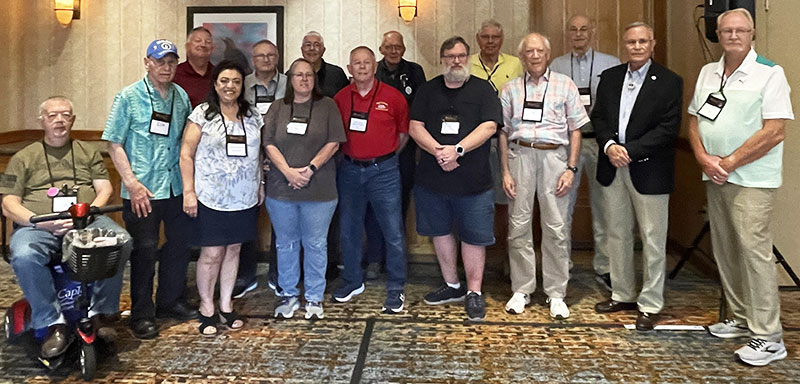
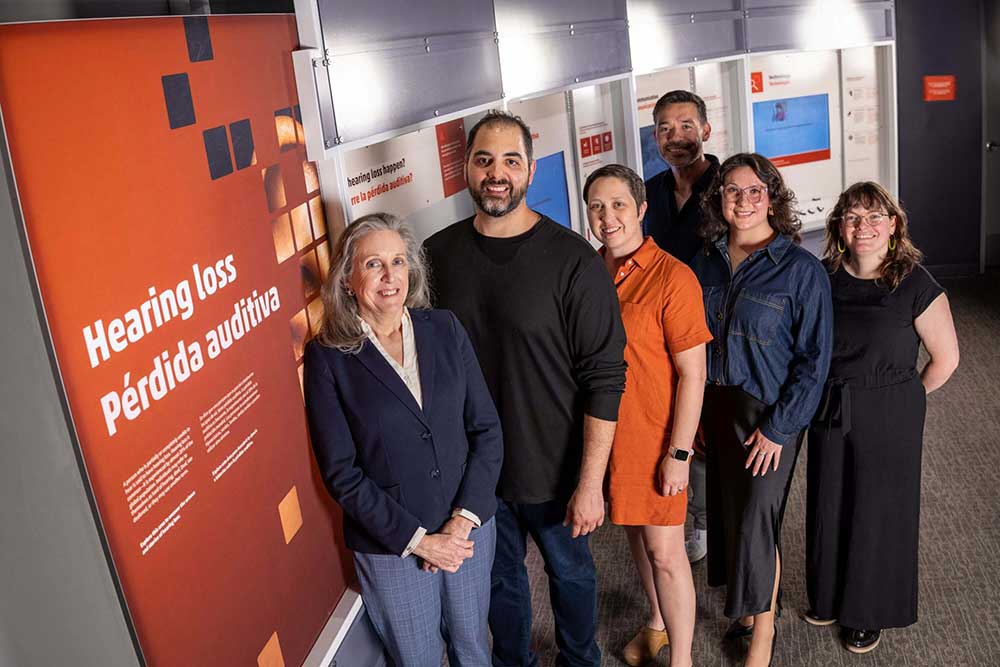
Miryam Fernandez, third from left, with other veterans at the HLAA 2024 Convention in Phoenix.
Miryam’s advice for veterans with hearing loss: “HLAA offers valuable support to veterans, so I highly recommend that you check it out.”
In 2023, Miryam was recognized for her community service with the Jerry Stein Memorial Independent Living Award from the Disabled Resources Center (DRC) in Long Beach, CA.
Bobby Graves: From Denial to HLAA Chapter President

Hearing loss background: Bobby, 70, developed hearing loss from exposure to noisy machinery. He wore bilateral hearing aids 1988-2024, and has been bimodal cochlear implant/hearing aid since 2024. He is the co-founder and president of the board of directors, HLAA Virginia Peninsula Chapter.
Military service: United States Army, active duty (1974-1982) and Reserves (1982-1997), rank E-6 Staff Sergeant and CW3, Chief Warrant Officer
Bobby’s story:

U.S. Army portrait of Bobby Graves at basic combat training.
“My hearing loss is a direct result of serving as a Military Occupational Specialty (MOS) 72G 30 Data Communications Center Specialist, where my work environment included destroying classified documents using large, loud machines and working with large mainframe computers daily.
“After departing from active duty, I noticed some trouble hearing while conversing with my spouse and others. As a veteran that has served my country faithfully, I was in immediate denial that I had a problem. When I entered the Reserves, although my work environment improved, the noise was still at dangerous levels. Later, working in a civilian job, several coworkers inquired about my understanding of conversations. Finally, at my wife’s urging, I submitted a claim to the Veterans Administration for potential hearing loss.

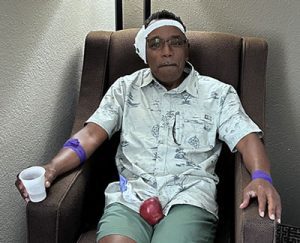
Bobby recovers after his cochlear implant surgery in 2024.
“I wore hearing aids in both ears for more than three decades, then received a cochlear implant in my right ear in 2024. During my treatment process, I received tremendous personal support from both the HLAA Virginia Beach Chapter and the Virginia Hearing Loss Support Network in Virginia Beach. In 2025, Thomas Blackman and I joined to establish the new HLAA Virginia Peninsula Chapter, assisted by Kenneth Reichert, membership coordinator of HLAA Virginia Beach, who continues to provide advice when needed.” (See the summer 2025 issue of Hearing Life magazine for more about this new chapter.)
Bobby’s advice for veterans with hearing loss: “If your car has a flat tire, you need a spare to finish your trip. If you have hearing loss, you need a hearing device. What are you waiting for? The journey of a joyful, exciting and rewarding life is ahead of you. Learn to advocate for yourself in situations where you find it hard to hear. On the phone, inform individuals that you have trouble hearing, especially those that speak too fast, have an accent or speak softly. Take advantage of the technology for hearing loss such as closed captioning features on mobile phones and other electronic devices. Let people know that if they walk in front of you are place their hands over the mouth, it is difficult to hear or understand their speech. Connect with a support group like HLAA and get involved.”
Ron Tallman: Combat Veteran Thrives with Cochlear Implants

Hearing loss background: Ron, 75, was diagnosed with profound noise-induced hearing loss and wears bilateral cochlear implants. He serves as president of the HLAA East Valley Chapter in Phoenix, Arizona.
Military service: United States Navy (1969-1992), ret. rank Lieutenant Commander. Served on the USS Savannah in Virginia, the Mediterranean Sea region and with the U.S. Pacific Fleet in support of the Viet Nam war. Stationed at the Naval Air Station, Barbers Point, HI, until retirement.
Ron’s story:
“I come from a family of six boys, who all served in the military in some capacity. We all have hearing loss, although I am the only one with CIs. Neither of our parents had a hearing loss, so it’s likely not genetic. I was first diagnosed at my retirement physical from the U. S. Navy in January 1992. While assigned to the USS San Bernardino (LST-1189), I was the sound powered phone talker, standing next to the Captain, passing his orders to gun control. The 3” 50 Caliber gun turret was about 12 feet away and I wore no hearing protection.

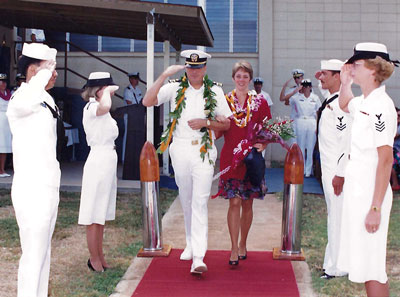
Ron Tallman and his wife at his retirement ceremony in 1992 at the Naval Air Station, Barbers Point, HI.
“During my retirement physical in 1992, when the doctor told me I had a significant hearing loss in my left ear, I responded “I hear fine, doc.” He said, “You do now, but as you get older your hearing loss will get worse.” Four years later, I received my first set of hearing aids and began my hearing loss journey. I used bilateral hearing aids for 15 years until one day, I woke up and went out to make coffee and talk to the dogs. They always greeted me, but this morning, I could not hear them. I put in my hearing aids and still could not make out the sounds, so I woke up my wife to let her know.
“My audiologist advised me to see an ENT (otolaryngologist), who tested me at 7% speech understanding in a clinical setting. After an MRI and a balance test, I was deemed a candidate for CIs. My right side was implanted in December 2013 and the left side in July 2014.

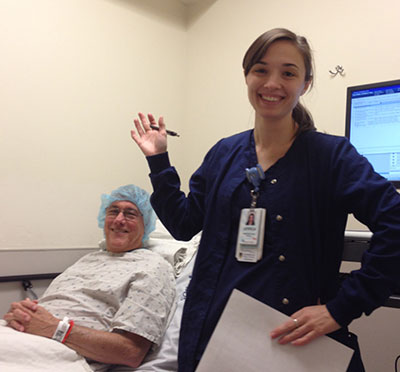
A health care professional with Ron in the hospital, just before his first cochlear implant surgery in 2013.
“Cochlear implants gave me my life back—hearing my wife’s voice, having conversations with my kids, being independent again, making my own appointments, talking on the phone and being involved with HLAA. It’s not an easy journey, and at times I still fall back and ask, ‘why did this happen to me?’ Then I stop and thank the many friends I have made along the way. I know this journey will never end—but I am not alone.
“I joined HLAA just prior to receiving my first cochlear implant and attended my first HLAA Convention in St. Louis in 2015. What a profound experience! I have never seen so many people with CIs in my life. All these people were just like me and understood what I go through every day. All the sessions had hearing loops and Communication Access Realtime Translation (CART) captioning. If you have hearing loss, this is the place you need to be.”
Ron’s advice for veterans with hearing loss: “Hearing loss does not just affect you as an individual, it affects your family, friends and relatives, and it knows no boundaries. Technology today is just amazing for those of us with hearing loss. We can talk on the phone, listen to music, attend Zoom meetings without complaining, go to movie or watch a movie on Netflix. Technology is boundless and it is only limited by what we do not know.”

By Teri Breier, communications specialist, Hearing Loss Association of America.
Enjoyed this post? Never miss out on future posts by following us.
Get the latest news and updates from HLAA
HearingU Webinars
HLAA regularly hosts webinars on a variety of hearing wellness topics. View the upcoming schedule or watch a previous video.
Follow HLAA on our social channels
If you or someone you know has a hearing loss, visit hearingloss.org for resources.
Find a local chapter or Walk4Hearing near you.
For questions, contact HLAA at inquiries@hearingloss.org.
Related Post
After delaying eight years to treat her hearing loss with a cochlear implant, Teri wishes she had done it sooner; read HLAA's third inspiring CI Day story.
Chapters Hear This! Blog Success Stories
Qais Khan is a passionate advocate for young adult cochlear implant recipients—read the second of HLAA's three inspiring stories for CI Day.
Advocacy Hear This! Blog Success Stories
Read about Doni, a young cochlear implant recipient, and his family in the first of three inspiring stories for International Cochlear Implant Day.
Hear This! Blog Success Stories
Flying for the holidays with hearing loss? Check out our 8 essential travel tips, advocate for your rights and learn a new way to file complaints.
Advocacy Hear This! Blog
Four members of the HLAA Task Force for Accessible, Inclusive Employment share career insights and workplace strategies for people with hearing loss.
Employment Hear This! Blog Technology
A groundbreaking exhibit on hearing loss at Boston's renowned Museum of Science was developed with involvement from a local HLAA Chapter.
Chapters Hear This! Blog Success Stories
Mobile phone makers have a new FCC deadline to implement Hearing Aid Compatibility (HAC) volume control standards to help people with hearing loss.
Advocacy Hear This! Blog Technology
Helpful back-to-school tips for parents of children with hearing loss from a pediatric audiologist and mom.
Advocacy Education Hear This! Blog
35 years after Americans with Disabilities Act (ADA) passed, the Hearing Loss Association of America (HLAA) is still fighting for access.
Accessible Communication Advocacy Hear This! Blog
Learn what's behind the new hearing aid battery packaging, why many are frustrated and what you can do to help.
Advocacy Chapters Hear This! Blog Technology
A clinical psychologist explores the wide-ranging effects of hearing loss and how education and self-advocacy can help reduce its psychological impact.
Hear This! Blog Living Well
The Early Hearing Detection and Intervention (EHDI) program is in jeopardy from proposed federal budget cuts, putting our nation’s infants at risk. Learn more and take action.
Advocacy Chapters Hear This! Blog