
Home » Travel

8 Tips for Holiday Air Travel with Hearing Loss

A jet airliner takes off from San Diego International Airport. ©San Diego International Airport

Flying for the Holidays?

Air travel this time of year is always challenging, especially for passengers with hearing loss. Check out our helpful strategies, advocate for your rights and learn a new way to file complaints with the Department of Transportation.

By HLAA Director of Public Policy Neil Snyder
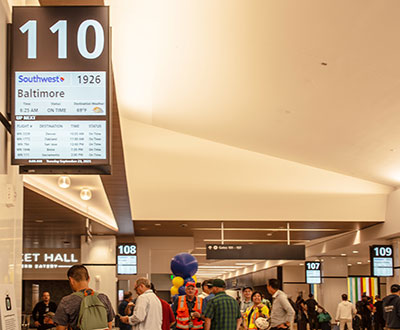
Airport flight display board

Airport boarding gate display sign with flight information. ©San Diego International Airport

The holiday season brings joy, family reunions and often a hectic trip through crowded airports. For travelers with hearing loss, the risk of missing important information due to muffled announcements is just one more obstacle to navigate in addition to long lines, gate changes and flight delays.

Airport flight display board

Airport boarding gate display sign with flight information. ©San Diego International Airport

Following these eight practical strategies can ease your travels and ensure smoother, safer flights.

  1. Book Early for Audio-Friendly Seating
    Book tickets far in advance so you can select seats near the front, where it’s easier to hear flight attendants.
  2. Self-Identify at Every Stage
    Indicate your hearing loss while buying your ticket, at security, at the gate and on the plane, to ensure staff can provide the support you need. Tell gate agents you’ll need boarding updates in writing or visually and remind them if necessary.
  3. Use Airline Apps and Text Alerts
    Winter storms and heavy traffic often mean delays. Most airlines send push notifications about gate changes or cancellations through their apps—install the app on your mobile device for updates.
  4. Pack Smart for Your Devices
    Bring chargers, power banks and extra batteries for hearing aids and cochlear implants. A speech-to-text app or remote microphone may help with conversations in noisy terminals.5
  5. Arrive Early and Request Preboarding
    The holidays mean fuller flights and more chaos, so plan an early arrival to get through security without pressure. Preboarding your plane lets you settle in and ensure that you hear or read crew instructions clearly.
  6. Know Your Options Onboard
    Many U.S. airlines offer closed-captioned safety videos and in-flight entertainment, printed safety instructions and front-of-cabin or adjacent seating to accommodate interpreters or companions. Use them each as needed.
  7. Use the Airport’s Hearing Assistance Resources
    Some airports now feature hearing loops or visual paging systems. Research ahead of time to learn where the tools are located. Many airports also participate in the Sunflower Lanyard program, which allows passengers to silently signal a hidden disability like hearing loss. You can typically request a lanyard at airport information centers.
  8. Fly Off-Peak with a Companion
    Try to plan your flights to avoid high-demand travel dates and times. If possible, traveling with a hearing friend or family member can reduce stress and anxiety.

Holiday travel can test anyone’s patience, but if you prepare and self-advocate, it doesn’t have to be overwhelming. With these tips, you’ll spend less time worrying about airport hassles and more time enjoying the holidays with family and friends.

Know Your Rights as a Passenger
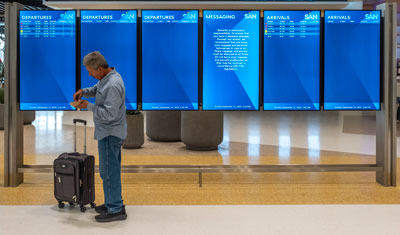
Airport visual paging and flight screens with a man in the foreground checking his phone.

Passenger in front of an airport flight board with visual messaging screen. ©San Diego International Airport

Knowing your rights before you travel helps avoid miscommunications at the busiest time of year for airports. All U.S. airlines must follow the Air Carrier Access Act (ACAA), which protects passengers with disabilities, including hearing loss. This milestone legislation was established in 1986 and ensures that air travel is accessible and non-discriminatory for people with disabilities, by requiring air carriers to accommodate their needs.

In 2022, the Department of Transportation (DOT) introduced the Airline Passengers with Disabilities Bill of Rights, which was supported by the Hearing Loss Association of America (HLAA) and other advocacy organizations. It includes provisions for accessible flight and safety information, preboarding and seating accommodations and the right to be treated with dignity and respect, among others.

Congress recently passed the Federal Aviation Administration FAA Reauthorization Act of 2024, requiring enhanced accommodations by September 2028, including fully accessible announcements, in-flight entertainment captioning and enhanced digital accessibility on airline websites and kiosks.

If Things Go Wrong, File a Complaint

Even with preparation, you may run into challenges during your travels. If you face accessibility issues, communication barriers or discrimination, you have options.

  • Start with the airline’s complaint resolution official (CRO). Every airline must provide a CRO trained in disability rights. Ask to speak with them before leaving the airport.
  • File a complaint through ACERS. In August 2025, the DOT modernized its Aviation Consumer Complaint and Enforcement Reporting System (ACERS), making it easier to submit accessibility complaints online. Gather details about your flight, the issue and any supporting documents in advance. Once submitted, your complaint is sent to the airline and DOT. A response from the airline is usually required within 30 days, and DOT monitors the results to enforce compliance.

Why file?
Filing a complaint ensures your voice is heard. Your feedback can help companies and the government spot systemic issues and the resulting improvements would benefit everyone with hearing loss.

File a Complaint


Neil Snyder

By Neil Snyder, director of public policy for the Hearing Loss Association of America (HLAA). Neil’s background spans more than 20 years of federal advocacy for hearing health and a decade on Capitol Hill. He can be reached at advocacy@hearingloss.org.


Enjoyed this post? Never miss out on future posts by following us.


Get the latest news and updates from HLAA

Topics(Required)

HearingU Webinars

HLAA regularly hosts webinars on a variety of hearing wellness topics. View the upcoming schedule or watch a previous video.

Watch a Webinar


Follow HLAA on our social channels


If you or someone you know has a hearing loss, visit hearingloss.org for resources.

Find a local chapter or Walk4Hearing near you.

For questions, contact HLAA at inquiries@hearingloss.org.

Home » Travel

Flying with Hearing Loss Could Soon Get Easier

New Air Travel Bill Includes Key Accessibility Improvements

It’s one of the most common complaints we get at the Hearing Loss Association of America (HLAA)—trouble hearing and understanding announcements in airports and airplanes—but changes are coming. A new bill mandates wide-ranging improvements to aviation safety and passenger protections, including significant benefits for travelers with hearing loss and other disabilities.

On May 16, the Federal Aviation Administration (FAA) Reauthorization Act of 2024 was signed into law by President Biden with bipartisan support. This vital bill extends the FAA’s activities related to airport planning and development, facilities, equipment and operations through September 30, 2028.

HLAA has worked for years with other consumer disability organizations, including the National Disability Rights Network (NDRN), National Association of the Deaf (NAD) and Paralyzed Veterans of America (PVA), to get important accessibility provisions included in the bill.

Here are some of the improvements to come:

  • Accessible announcements
    Those muffled, hard-to-understand gate and safety announcements could get more accessible. Under the new law, all airport gates, counters, ticketing areas and customer service desks must be disability accessible, including captions for people with hearing loss.
  • New wheelchair safety standards
    Harrowing scenarios of wheelchair damage and injuries to passengers who are taken in and out of them could diminish as the bill requires the Department of Transportation (DOT) to improve standards for wheelchair transport and stowage.
  • In-flight entertainment captioning
    DOT is required to issue new regulations requiring in-flight entertainment accessibility, including closed captioning and video descriptions.
  • Digital accessibility
    Minimum standards to ensure that individuals with disabilities can access websites, software applications and kiosks are also included.

In addition, the FAA Reauthorization Act addresses a variety of general transportation issues, such as the Airport Improvement Program (AIP), aviation workforce development and air traffic controller recruitment, aircraft and pilot certifications, guaranteed family seating policies, the elimination of hidden airline fees and hassle-free refunds to passengers for delayed or canceled flights.

Changes could still be some way off, but this is certainly a big step in the right direction. We know this is a critical safety issue for millions with hearing loss, and ultimately will benefit all travelers in noisy airports and airplanes. A 2023 blog post about protecting yourself while traveling with hearing loss remains one of our top performers, and according to HLAA Executive Director Barbara Kelley, the topic is second only to concerns about the costs of hearing aids and lack of insurance coverage.

If you have hearing loss and are flying, preparation can be key to your safety and success. Know your rights before you go and see other important initiatives that HLAA is working on.

Plan ahead and know your rights

HLAA encourages all travelers with hearing loss and other disabilities to learn what your rights are, prepare well in advance and self-advocate at every step. Be sure to take these actions when planning your travel, whether you’re going on vacation, a business trip, the HLAA Convention or visiting family for the holidays:

    1. When ordering your ticket, identify yourself as someone with hearing loss.
    2. If traveling with a service animal, complete and submit all paperwork in advance.
    3. Review the online accessibility policies of the airports you’re using—departure, destination, and any connection. Find out what accommodations are available and where.
    4. At the airport, self-identify at every point of contact; in particular, ensure that gate agents are aware that you may not be able to hear announcements and require preboarding.
    5. Familiarize yourself with Aviation Consumer Protection materials for travelers with disabilities from the U.S. Department of Transportation (DOT) and the new Airline Passengers Disability Bill of Rights
    6. Report any disability-related air travel issues to the airline first, then to U.S. DOT if your complaint remains unresolved.

Neil Snyder

By Neil Snyder, director of public policy, Hearing Loss Association of America


Enjoyed this post? Never miss out on future posts by following us.


Get the latest news and updates from HLAA

This field is for validation purposes and should be left unchanged.
First Name(Required)

HearingU Webinars

HLAA regularly hosts webinars on a variety of hearing wellness topics. View the upcoming schedule or watch a previous video.

Watch a Webinar


Follow HLAA on our social channels


If you or someone you know has a hearing loss, visit hearingloss.org for resources.

Find a local chapter or Walk4Hearing near you.

For questions, contact HLAA at inquiries@hearingloss.org.

Home » Travel

Flying with Hearing Loss Can Be Challenging

Planning ahead and knowing your rights can help

A recent news story about a senior woman’s air travel nightmare highlights problems many of us with hearing loss may experience when we fly. Often announcements and even safety information aren’t accessible. How can we stay safe, remain informed and minimize issues while traveling? 

Airport nightmare in Austin

According to the Austin Chronicle, Karen McGee, a 71-year-old woman with hearing loss flying alone for the first time last September, missed her connecting flight during a layover at Austin–Bergstrom International Airport in Texas when she didn’t hear a gate change announcement. She reportedly became agitated when airline personnel couldn’t communicate with her.

Karen McGee at the airport being escorted out

Karen McGee and police at Austin airport (screenshot via Austin PD bodycam footage)

Austin news station KXAN reports that police were called but had trouble communicating with her. The details aren’t clear, but in the end, McGee was apparently arrested for trespassing, handcuffed, taken to the local jail, detained for two nights, and ended up with a broken wrist.

What happened in Austin—however elusive—brings up some of our worst fears as travelers with the invisible disability of hearing loss. Regardless of the details in this particular case, we can learn from it and make our own travels less distressing with a bit of preparation.

Discrimination against travelers with disabilities is illegal 

The Air Carrier Access Act (ACAA) is a 1986 law—predating the Americans with Disabilities Act (ADA) by four years—that makes it illegal for airlines to discriminate against passengers because of their disability. The Department of Transportation is responsible for enforcing the ACAA, which applies to all flights to, from, or within the United States.

One of its provisions is that anyone self-identifying as a passenger with a disability, who needs additional time or assistance, must be allowed to board the airplane before other passengers. Hearing loss is considered a disability under the ACAA, just as it is for the ADA.

Lise with her hearing dog, Shine

Lise Hamlin with her hearing dog, Shine, at an airport

Self-identifying can help  

I once almost missed a flight because I did not hear the boarding announcement at a very busy area with multiple gates at Reagan National Airport. Another time, I missed an important safety announcement about the plane’s potential landing gear issue during a flight descent. Luckily, in both cases, I was able to avoid serious complications, but since then, I have self-identified at every point in the travel process: when purchasing my ticket, at the ticketing counter, at TSA security, at the airline gate, when boarding the plane, and if needed, at baggage claim.

By staying alert to my surroundings, I have never missed a flight. I also make sure the airline knows in advance I am flying with my hearing dog, Shine, and complete all the required service animal paperwork. Gate personnel often help me understand the preboarding announcements and ensure I get on with those in front of the line.

Airline agents responsible for providing accommodations 

Had McGee been aware of the ACAA, she could have disclosed her disability and requested preboarding at her first gate. At that time, flight agents would have been required to ensure that she receives the same information as everyone else. She would have learned about the gate change, found the new gate, and been allowed to preboard successfully.

McGee may not have known her rights under the ACAA, which is not uncommon for the millions of us who now have hearing loss. Had she known and self-identified, what could the gate agents have offered as accommodation? One option might have been hearing loops, an assistive listening method provided by a growing number of public spaces including airports. Hearing loops can feed sound directly into a person’s hearing aid or cochlear implant when equipped with a telecoil.

According to the Accessibility page of its website, the Austin Airport has a loop installed between Gates 1 and 12. If her hearing aids had an activated telecoil, a mechanism to receive the input from a hearing loop, and if the agents knew how to use the hearing loop, it’s certainly possible that McGee could have communicated more effectively and made it to her connecting flight.

But an air carrier’s responsibility doesn’t end if one’s hearing device doesn’t work, or if the gate is not equipped with a hearing loop. There are far more options to provide access than even a few years ago. Speech to text apps on a cellphone or tablets provided at gates could be used. A pocket talker, or small sound amplifying device, might have been available. Even old-school pen and paper could be used in a pinch.

A call for more awareness, education and empathy  

Beyond assistive technology, the most important accommodation is simple compassion and understanding for people traveling with disabilities. In this case, communication broke down and gate agents had the police take this 71-year-old woman with hearing loss to jail.

Lisa with her hearing dog Shine

Lise and Shine at home

It’s important to note that airports are complex places and accessibility falls under multiple jurisdictions. For instance, in this case, the airport itself is under the jurisdiction of the city of Austin, which must follow ADA regulations as well as Federal Aviation Administration (FAA) rules. Departure gates, ticketing counters, airplanes and baggage fall under the ACAA for people with disabilities, so Austin has no control over what the air carriers provide.

The ACAA has been law for decades, but still very few people are aware of it. Had McGee or the flight agents been more knowledgeable about this law, her harrowing experience may have been avoided. The Hearing Loss Association of America (HLAA) continues to advocate for more comprehensive training about required accommodations under both the ACAA and ADA, for all airline and airport personnel, and enhanced assistive communications at every airport such as visual messaging, hearing loops and more. With our support, Congressional co-sponsors have proposed a new ACAA Amendment Act, requiring more text and accessible information. HLAA also wants passengers with hearing loss to be empowered with information before they travel.

Plan ahead and know your rights

HLAA encourages all travelers with hearing loss and other disabilities to learn what your rights are, prepare well in advance and self-advocate at every step. Be sure to take these actions when planning your travel, whether you’re going on vacation, a business trip, family reunion or attending the annual HLAA Convention:

    1. When ordering your ticket, identify yourself as someone with hearing loss.
    2. If traveling with a service animal, complete and submit all paperwork in advance.
    3. Review the online accessibility policies of the airports you’re using—departure, destination, and any connection. Find out what accommodations are available and where.
    4. At the airport, self-identify at every point of contact; in particular, ensure that gate agents are aware that you may not be able to hear announcements and require preboarding.
    5. Familiarize yourself with Aviation Consumer Protection materials for travelers with disabilities from the U.S. Department of Transportation (DOT) and the new Airline Passengers Disability Bill of Rights
    6. Report any disability-related air travel issues to U.S. DOT and/or to the airline.

lise-hamlin-200

By Lise Hamlin

As HLAA’s director of public policy, Lise Hamlin, a cochlear implant user, has been an advocate for people with hearing loss for three decades. She works directly with consumers to help them understand their rights and responsibilities under the Americans with Disabilities Act and other disability laws like the Air Carrier Access Act. Lise also represents HLAA on federal advisory committees, industry advisory groups, and consumer coalitions, including the Federal Communications Commission’s Disability Advisory Committee, Transportation Security Administration’s Disability and Medical Condition Coalition and other organizations, advocating legislation that supports the rights of millions of Americans with hearing loss.


Enjoyed this post? Never miss out on future posts by following us.


Get the latest news and updates from HLAA

This field is for validation purposes and should be left unchanged.
First Name(Required)

HearingU Webinars

HLAA regularly hosts webinars on a variety of hearing wellness topics. View the upcoming schedule or watch a previous video.

Watch a Webinar


Follow HLAA on our social channels


If you or someone you know has a hearing loss, visit hearingloss.org for resources.

Find a local chapter or Walk4Hearing near you.

For questions, contact HLAA at inquiries@hearingloss.org.