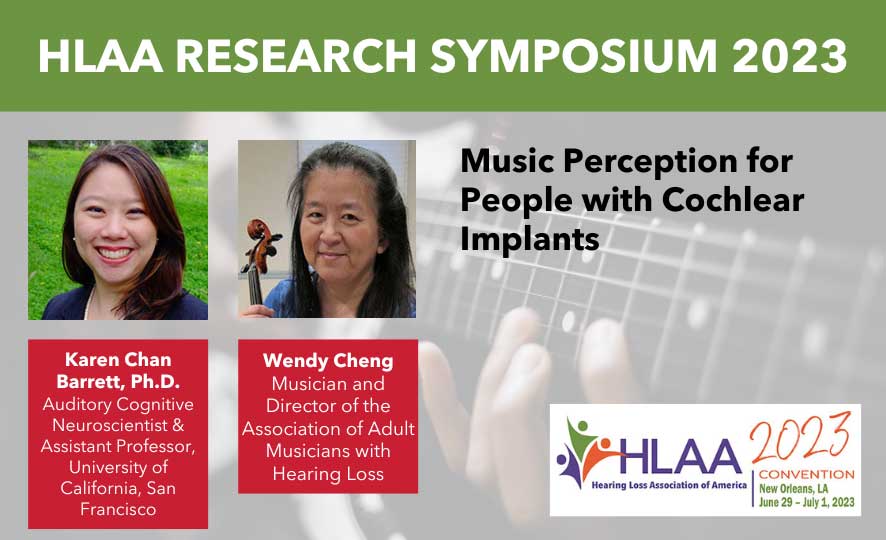
Music perception is difficult for both cochlear implant (CI) and hearing aid (HA) users due to the devices’ technological constraints and music’s acoustic complexity. This presentation focuses on current research innovations to improve music perception for individuals with hearing loss, based on Dr. Karen Barrett’s extensive background at the intersection of science, music and health. She addresses how musical training interventions and novel research innovations, such as processing strategies and individualized pitch maps, improve music perception, then discusses the resources of the Sound Health Network (SHN)—an interagency collaboration to promote public awareness and research about the impact of music on wellness—to stay up-to-date with music perception and hearing loss research. Wendy Cheng rounds out this segment from a musician’s perspective, sharing her experience of performing with hearing loss while wearing CIs.
Presenters: Karen Chan Barrett, Ph.D., auditory cognitive neuroscientist & assistant professor, University of California, San Francisco and Wendy Cheng, musician and director of the Association of Adult Musicians with Hearing Loss.
This video from the Hearing Loss Association of America (HLAA), is edited from a live Research Symposium presented on June 30, 2023 at its annual convention in New Orleans.
Presented by
 Karen Chan Barrett, Ph.D.
Auditory Cognitive Neuroscientist & Assistant Professor, University of California, San Francisco
Dr. Karen Chan Barrett is an Assistant Professor at the University of California, San Francisco (UCSF) with a joint appointment at the Institute for Health & Aging in the School of Nursing and the Department of Otolaryngology in the School of Medicine. As an auditory cognitive neuroscientist, her research interests include the neuroscience of creativity, music perception in cochlear implant users and music and health. Using behavioral and neuroimaging methods, she investigates complex sound perception in cochlear implant users and neural correlates of artistic creativity and improvisation. A musician herself, Karen began playing classical piano at age five and earned dual master’s degrees in piano performance and musicology at the Peabody Institute of Music. Concurrently, she studied neuroscience, first at Wellesley College and then in her Music Theory and Cognition Ph.D. program at Northwestern University.
Wendy Cheng, Founder
Association of Adult Musicians with Hearing Loss
Wendy Cheng is a bilateral cochlear implant recipient who is also a passionate amateur musician. When she is not practicing her viola, directing her community handbell choir or studying music theory, she can be found planning events for her nonprofit, the Association of Adult Musicians with Hearing Loss. She also serves on the steering committee for the Montgomery County (MD) chapter of Hearing Loss Association of America.
Research reported in this publication was supported by the National Institute On Deafness And Other Communication Disorders of the National Institutes of Health under Award Number R13DC017913. The content is solely the responsibility of the authors and does not necessarily represent the official views of the National Institutes of Health.

 Karen Chan Barrett, Ph.D.
 Wendy Cheng, Founder